韓国語と、もう少し近くに
PADOラウンジ
会員登録なしで、PADO GMの絵カードや学習の話を読めます。
読んだら、やってみましょう
会員登録もワークブックのコードも不要で、短い韓国語の練習を体験できます。
公開の学習記事 67
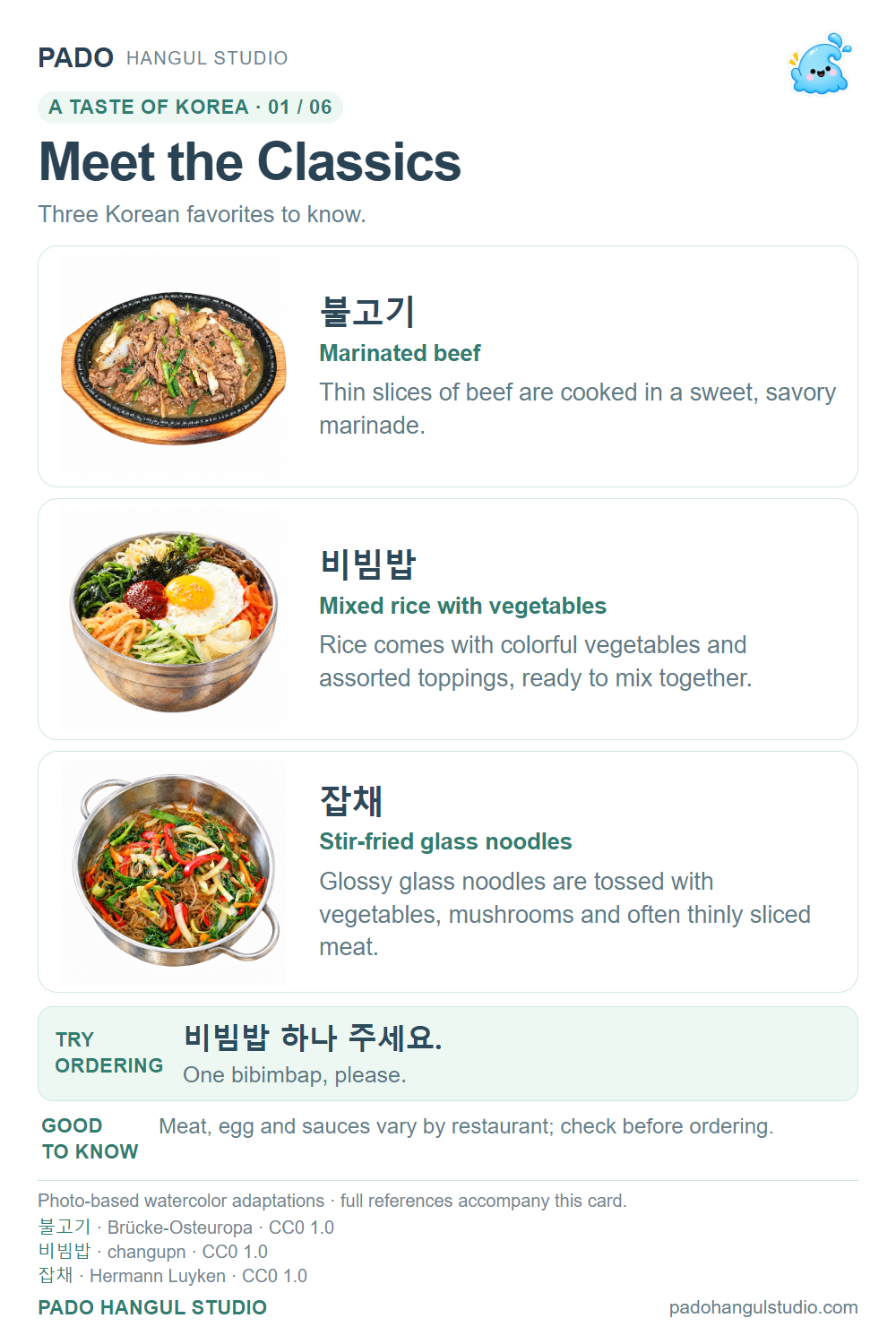
Bulgogi, bibimbap and japchae offer three different ways to begin exploring Korean food. Match the Korean names with the dishes, then try a simple order.
불고기 · Marinated beef
Thin slices of beef are cooked in a sweet, savory marinade.
비빔밥 · Mixed rice with vegetables
Rice comes with colorful vegetables and assorted toppings, ready to mix together.
잡채 · Stir-fried glass noodles
Glossy glass noodles are tossed with vegetables, mushrooms and often thinly sliced meat.
Try saying
비빔밥 하나 주세요.
One bibimbap, please.
Meat, egg and sauces vary by restaurant; check before ordering.
Which of these three would you try first?
An editorial selection for language learners, not an official ranking.
Illustration credits
The illustrations are AI-assisted watercolor adaptations of the following photographs; backgrounds and unrelated items were removed. Source-specific changes are listed below.
불고기 (Marinated beef)
Photo: Bulgogi in Seoul.jpg — Brücke-Osteuropa
Source: https://commons.wikimedia.org/wiki/File:Bulgogi_in_Seoul.jpg
License: CC0 1.0 — https://creativecommons.org/publicdomain/zero/1.0/
Changes: Thin cooked beef, onion, scallion, sesame, oval black platter and wooden support retained; background removed.
비빔밥 (Mixed rice with vegetables)
Photo: Bibimbap with kkakdugi.jpg — changupn
Source: https://commons.wikimedia.org/wiki/File:Bibimbap_with_kkakdugi.jpg
License: CC0 1.0 — https://creativecommons.org/publicdomain/zero/1.0/
Changes: Vegetable sections, gochujang and egg retained in original metal bowl; side dish and table removed.
잡채 (Stir-fried glass noodles)
Photo: 2016.06.11.105029 Japchae Heidelberg.jpg — Hermann Luyken
Source: https://commons.wikimedia.org/wiki/File:2016.06.11.105029_Japchae_Heidelberg.jpg
License: CC0 1.0 — https://creativecommons.org/publicdomain/zero/1.0/
Changes: Compared with selected CC0 real photograph: brown translucent noodles with red pepper, carrot, onion, mushrooms and green leaves retained in a handled metal pot. No added meat/egg; table and trivets removed.
続きを読む →Visiting Korea in Winter? Sea Views, a Seasonal Festival and Seoul
編集済み ·
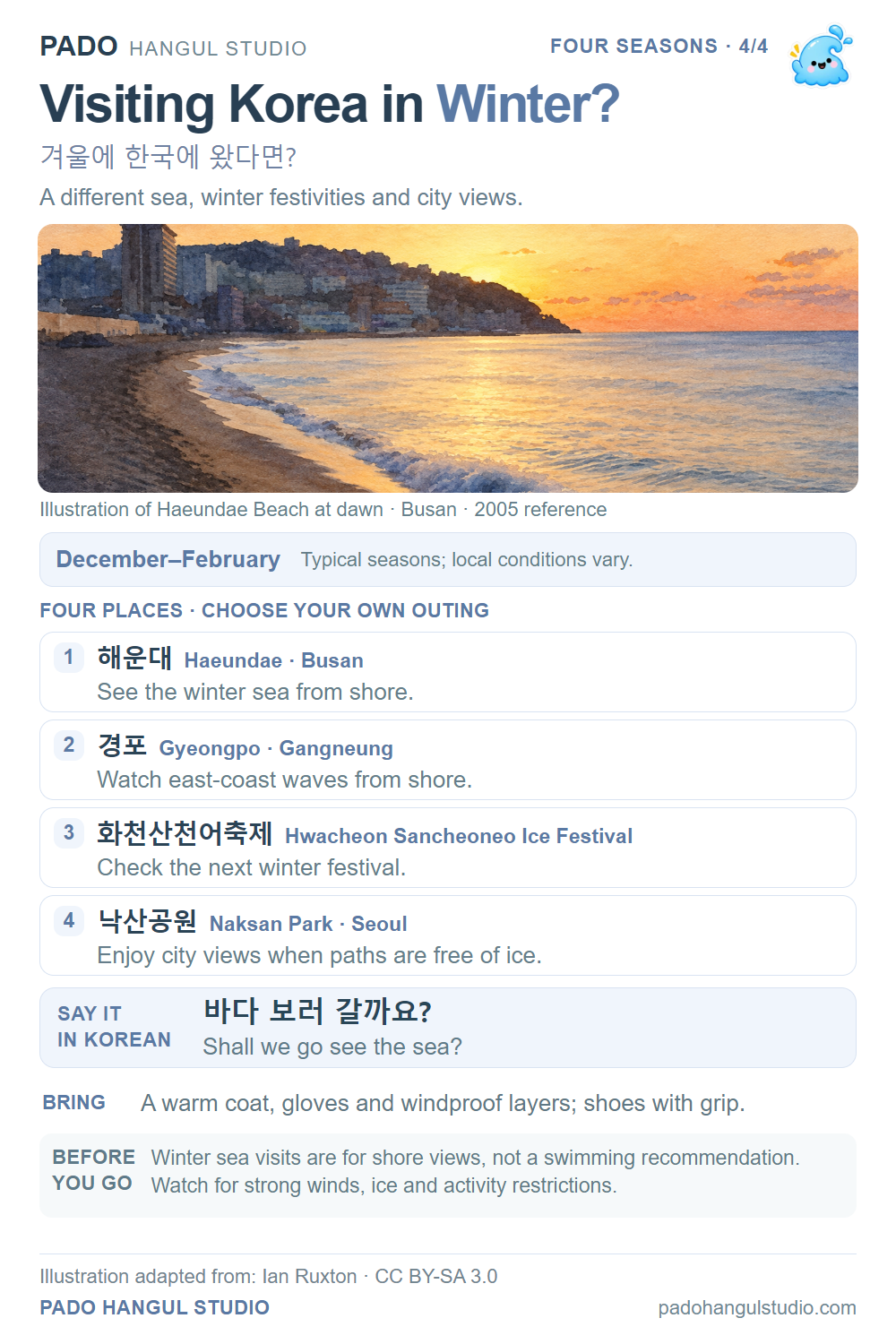
Visiting Korea in winter? The sea has a different mood from summer. This card suggests shore views at 해운대 (Haeundae) in Busan and 경포 (Gyeongpo) in Gangneung, a look at the next 화천산천어축제 (Hwacheon Sancheoneo Ice Festival), and a short city-view outing at 낙산공원 (Naksan Park) in Seoul. Choose a region and plan at your own pace.
Winter beach visits here mean looking at the sea and walking on permitted shore paths, not a swimming recommendation. Enjoy the changing light and sound of waves while keeping away from restricted, wave-exposed areas. Winter does not guarantee an empty beach, calm conditions or a particular view. Strong coastal winds make warm, windproof layers useful.
Hwacheon's winter festival typically runs around January and early February. Look up the next edition's official dates, booking information and current activity conditions. Ice-fishing or snow activities depend on weather and the organizer's controls; do not assume they are always available.
For Naksan, choose a brief walk when steps and paths are free of ice, and remember the hills and stairs. Start with enough daylight and change your plan if conditions worsen. A winter city trip can also include a separate, short visit to a palace or a traditional neighborhood, with its own opening and closure checks.
Winter broadly covers December to February, but snow and ice vary by place and day. Bring a warm coat, gloves and shoes with grip. Practice 바다 보러 갈까요?—“Shall we go see the sea?” What would your winter outing look like?
Illustration reference: Haeundae Beach, Busan, photographed by Ian Ruxton on 21 February 2005. The header illustrates this one real place; the four destinations in the text are separate outing ideas.
Changes for this card: the reference photograph was adapted into watercolor with AI, fine details were simplified and the illustration was cropped for the layout. This historical reference does not verify the place’s current appearance or access conditions.
Original Commons source: https://commons.wikimedia.org/wiki/File:Haeundae_beach.jpg
Reference photo license: CC BY-SA 3.0
https://creativecommons.org/licenses/by-sa/3.0/
Adapted watercolor artwork: CC BY-SA 3.0
https://creativecommons.org/licenses/by-sa/3.0/
This license notice applies to the adapted illustration; PADO text, layout, logo and mascot are separate.
#LearnKorean #KoreaInWinter #PADO
続きを読む →Visiting Korea in Autumn? Mountain Colors, Reeds and Tradition
編集済み ·
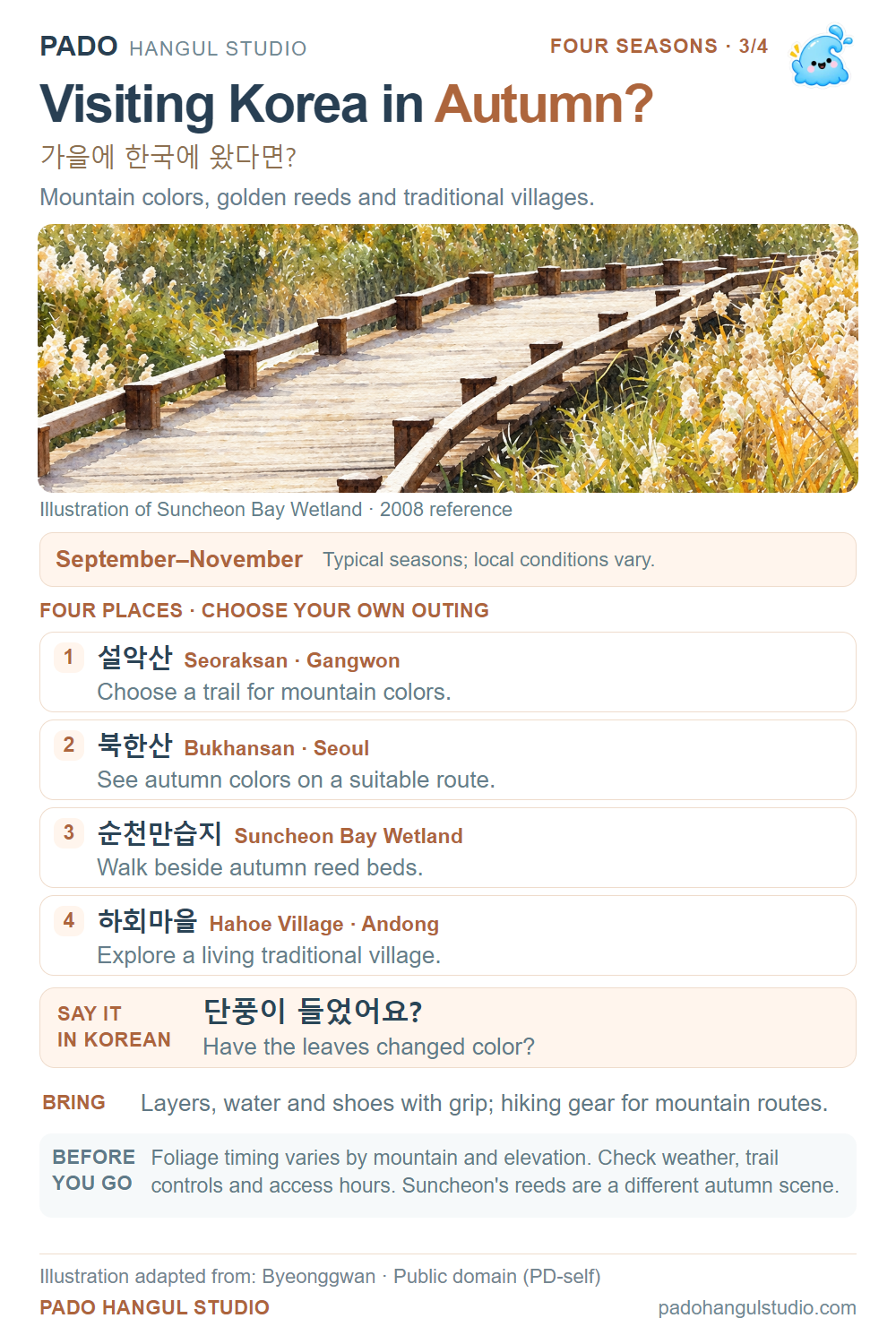
Visiting Korea in autumn? The season offers more than one kind of scenery. This card pairs 설악산 (Seoraksan) and 북한산 (Bukhansan) with 순천만습지 (Suncheon Bay Wetland) and 하회마을 (Hahoe Village) in Andong. These are independent destinations, not one day's route.
For a Seoul mountain list, consider 남산 (Namsan), 아차산 (Achasan), 인왕산 (Inwangsan) and 북한산 (Bukhansan). Across Korea, explore route options at 설악산 (Seoraksan), 지리산 (Jirisan), 무등산 (Mudeungsan) and 한라산 (Hallasan). A mountain's name alone does not tell you the difficulty: shorter park or valley walks and steep, rocky summit routes are very different outings. Choose a marked route that fits your experience, equipment and available daylight.
Check reservations for the particular trail. Hallasan's upper summit sections via Seongpanak and Gwaneumsa, Jirisan's upper Nogodan section and Bukhansan's Uiryeong route have specific rules. Do not assume all trails on those mountains need the same reservation. Current closures and entry cutoffs still apply.
Autumn broadly spans September to November. Northern and higher slopes can change earlier, but weather, elevation and the year affect foliage timing. Check current conditions rather than planning around one fixed peak date.
At Suncheon Bay Wetland, look for autumn reed scenery, not tree foliage. The wetland and Suncheon Bay National Garden are different sites. For tradition, explore Hahoe's living village; Jeonju Hanok Village and Bulguksa Temple are additional regional options. Jinju's lantern festival typically falls in October—check the next edition's notice.
Bring layers, water and suitable footwear. Practice 단풍이 들었어요?—“Have the leaves changed color?” Which autumn scene would you choose?
Illustration reference: Suncheon Bay Wetland, photographed by Byeonggwan on 21 October 2008. The header illustrates this one real place; the four destinations in the text are separate outing ideas.
Changes for this card: the reference photograph was adapted into watercolor with AI, fine details were simplified and the illustration was cropped for the layout. This historical reference does not verify the place’s current appearance or access conditions.
Original Commons source: https://commons.wikimedia.org/wiki/File:Suncheon6.jpg
Reference photo license: Public domain (PD-self)
https://commons.wikimedia.org/wiki/File:Suncheon6.jpg#Licensing
The original photographer released the reference into the public domain (PD-self); it is not labeled CC0.
#LearnKorean #KoreaInAutumn #PADO
続きを読む →Visiting Korea in Summer? Beaches, River Evenings and a Festival
編集済み ·
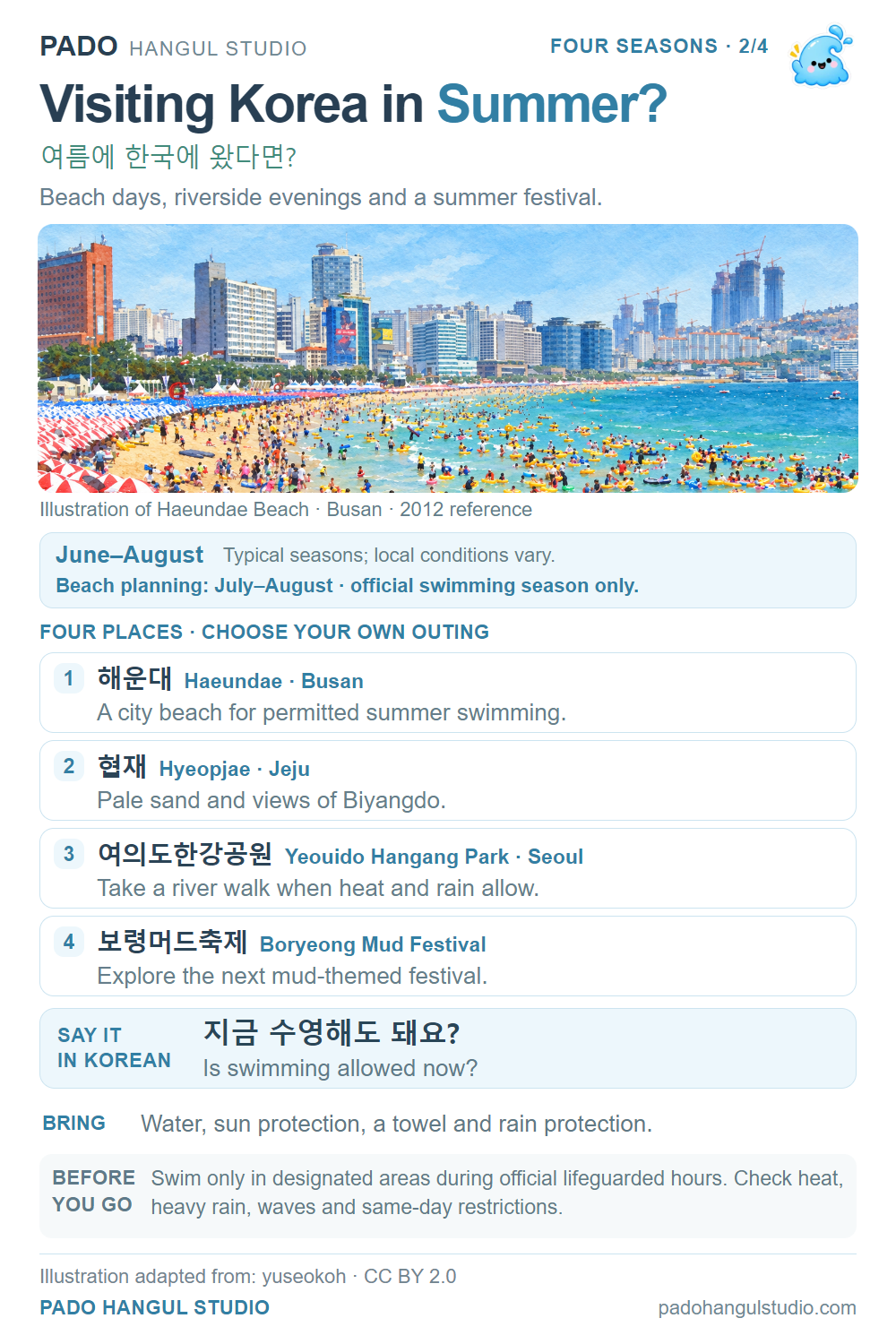
Visiting Korea in summer? Choose a permitted beach day, a weather-friendly river walk or a seasonal festival. This card highlights 해운대 (Haeundae) in Busan, 협재 (Hyeopjae) on Jeju, 여의도한강공원 (Yeouido Hangang Park) in Seoul and 보령머드축제 (Boryeong Mud Festival). They are separate choices across different regions.
For a wider beach list, add 경포 (Gyeongpo) in Gangneung on the east coast and 대천 (Daecheon) in Boryeong on the west coast. Haeundae offers a city-beach setting, while Hyeopjae has pale sand and a view toward Biyangdo Island. July and August are useful planning months for swimming at all four beaches, but the actual opening period differs by beach and year. Do not assume every date in those months is open.
Swim only in designated areas during official lifeguarded hours, and check the day's waves, weather and entry restrictions. A beach being open for a shore walk does not mean swimming is permitted.
In Seoul, try a short evening walk within Yeouido Hangang Park when heat and rain allow. Check riverside access notices after heavy rain. Boryeong's mud festival typically takes place around late July and early August; look up the next edition's dates, activities and booking requirements.
Bring water, sun protection, rain protection and a towel for a beach visit. Practice 지금 수영해도 돼요?—“Is swimming allowed now?” Would you choose the sea, the river or a festival?
Illustration reference: Haeundae Beach, Busan, photographed by yuseokoh on 1 August 2012. The header illustrates this one real place; the four destinations in the text are separate outing ideas.
Changes for this card: the reference photograph was adapted into watercolor with AI, fine details were simplified and the illustration was cropped for the layout. This historical reference does not verify the place’s current appearance or access conditions.
Original Commons source: https://commons.wikimedia.org/wiki/File:%22Hae-Un-Dae%22_Beach,_Sunny_Day.(Busan_City,_Korea)_(8661277231).jpg
Reference photo license: CC BY 2.0
https://creativecommons.org/licenses/by/2.0/
#LearnKorean #KoreaInSummer #PADO
続きを読む →Visiting Korea in Spring? Palace Walks, Blossoms and Hanok Streets
編集済み ·
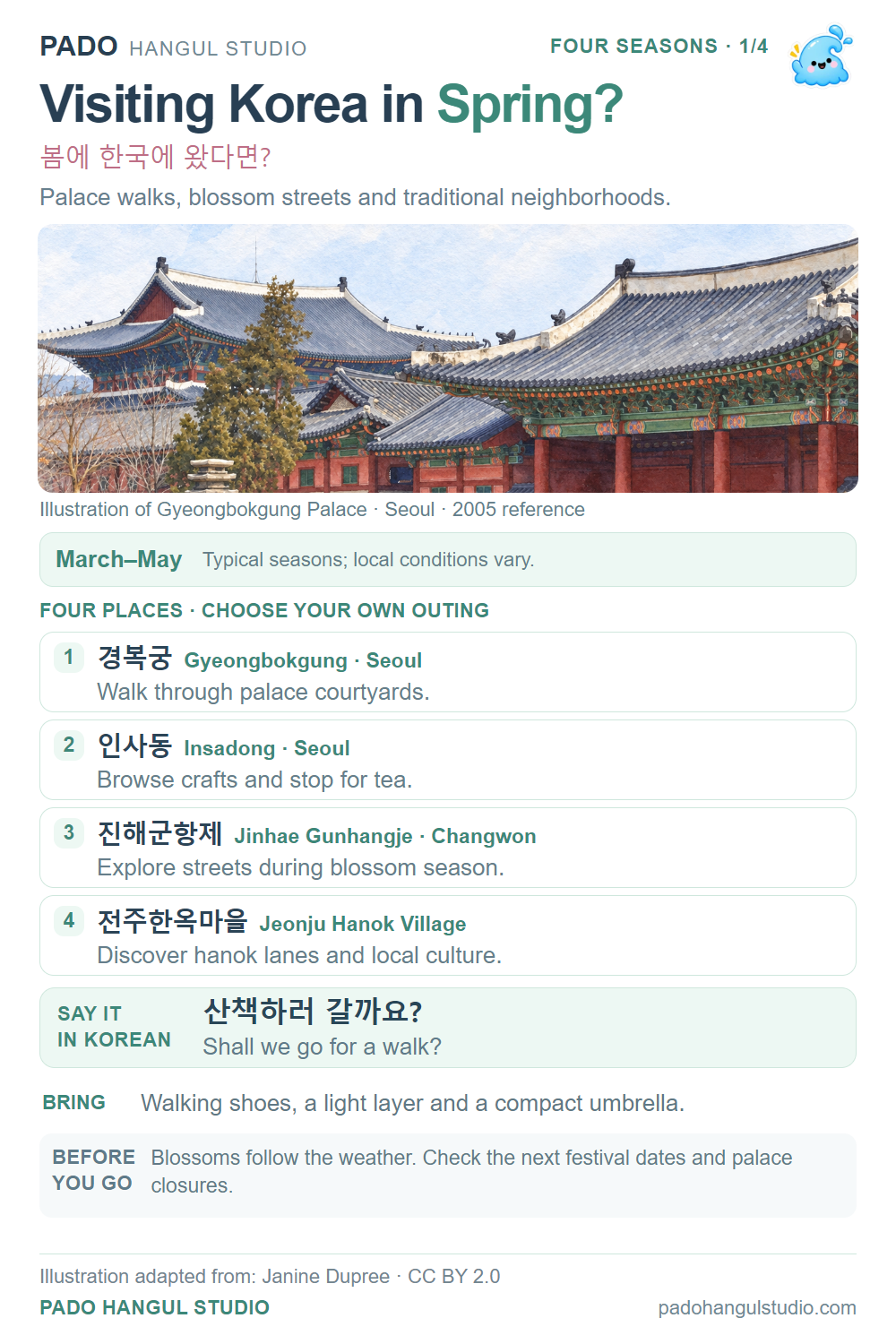
Visiting Korea in spring? Start with a place that matches your interests: palace courtyards, traditional crafts, blossom-season streets or a hanok neighborhood. The four choices on this card are separate outing ideas, not a route to complete in one day.
In Seoul, 경복궁 (Gyeongbokgung Palace) offers a closer look at royal architecture. 인사동 (Insadong) is a place to browse crafts, galleries and traditional tea shops. Further south, 진해군항제 (Jinhae Gunhangje) brings a spring festival to Changwon's Jinhae area, while 전주한옥마을 (Jeonju Hanok Village) offers hanok lanes and opportunities to explore Korean culture.
Spring broadly runs from March to May, but blossoms do not follow one nationwide timetable. Jinhae's festival typically falls around late March and early April; check the next edition's official dates and current blossom conditions before planning around it. Gyeongbokgung usually closes on Tuesdays, with public-holiday exceptions. Specific palace programs can require advance booking even when ordinary entry does not.
If history interests you, keep 불국사 (Bulguksa Temple) in Gyeongju and 하회마을 (Hahoe Village) in Andong on your list for a separate regional trip. Respect worship, residents and private spaces.
Bring comfortable walking shoes, a light layer and a compact umbrella. Practice 산책하러 갈까요?—“Shall we go for a walk?” Which spring outing would you choose first?
Illustration reference: Gyeongbokgung Palace, Seoul, photographed by Janine Dupree on 17 March 2005. The header illustrates this one real place; the four destinations in the text are separate outing ideas.
Changes for this card: the reference photograph was adapted into watercolor with AI, fine details were simplified and the illustration was cropped for the layout. This historical reference does not verify the place’s current appearance or access conditions.
Original Commons source: https://commons.wikimedia.org/wiki/File:Gyeongbokgung_Palace.jpg
Reference photo license: CC BY 2.0
https://creativecommons.org/licenses/by/2.0/
#LearnKorean #KoreaInSpring #PADO
続きを読む →Ways to Say Beautiful in Korean
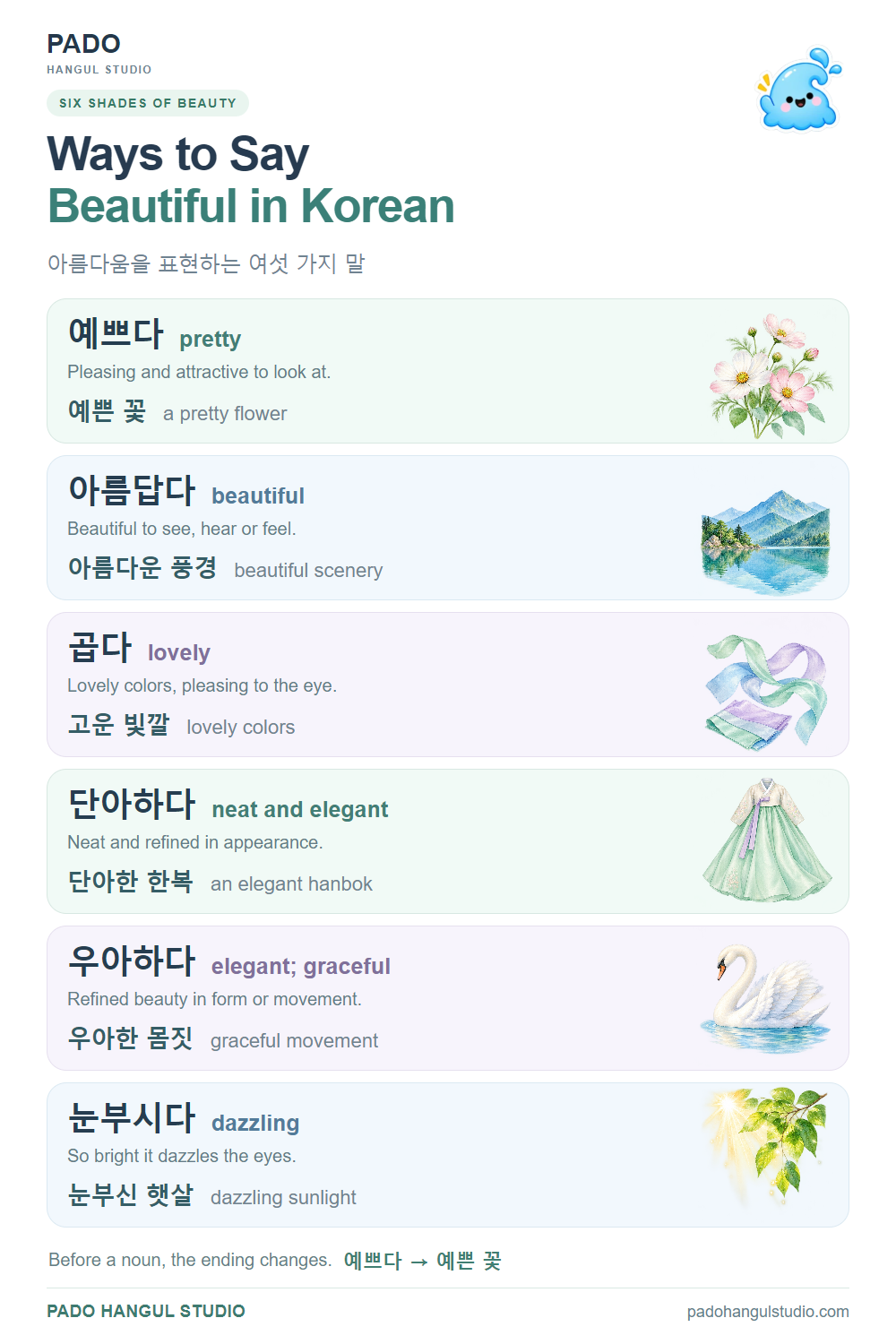
예쁘다 often means “pretty” in appearance. 아름답다 can describe beauty in sights, sounds or feelings. Explore lovely color, neat elegance, graceful movement and dazzling light, too.
예쁜 꽃 — a pretty flower
아름다운 풍경 — beautiful scenery
고운 빛깔 — lovely colors
단아한 한복 — a neat, elegant hanbok
우아한 몸짓 — graceful movement
눈부신 햇살 — dazzling sunlight
The ending changes before a noun. Choose one expression and write a short phrase. What would you describe?
#LearnKorean #KoreanVocabulary #PADOHangulStudio
続きを読む →Four Korean Snacks, One Simple Order
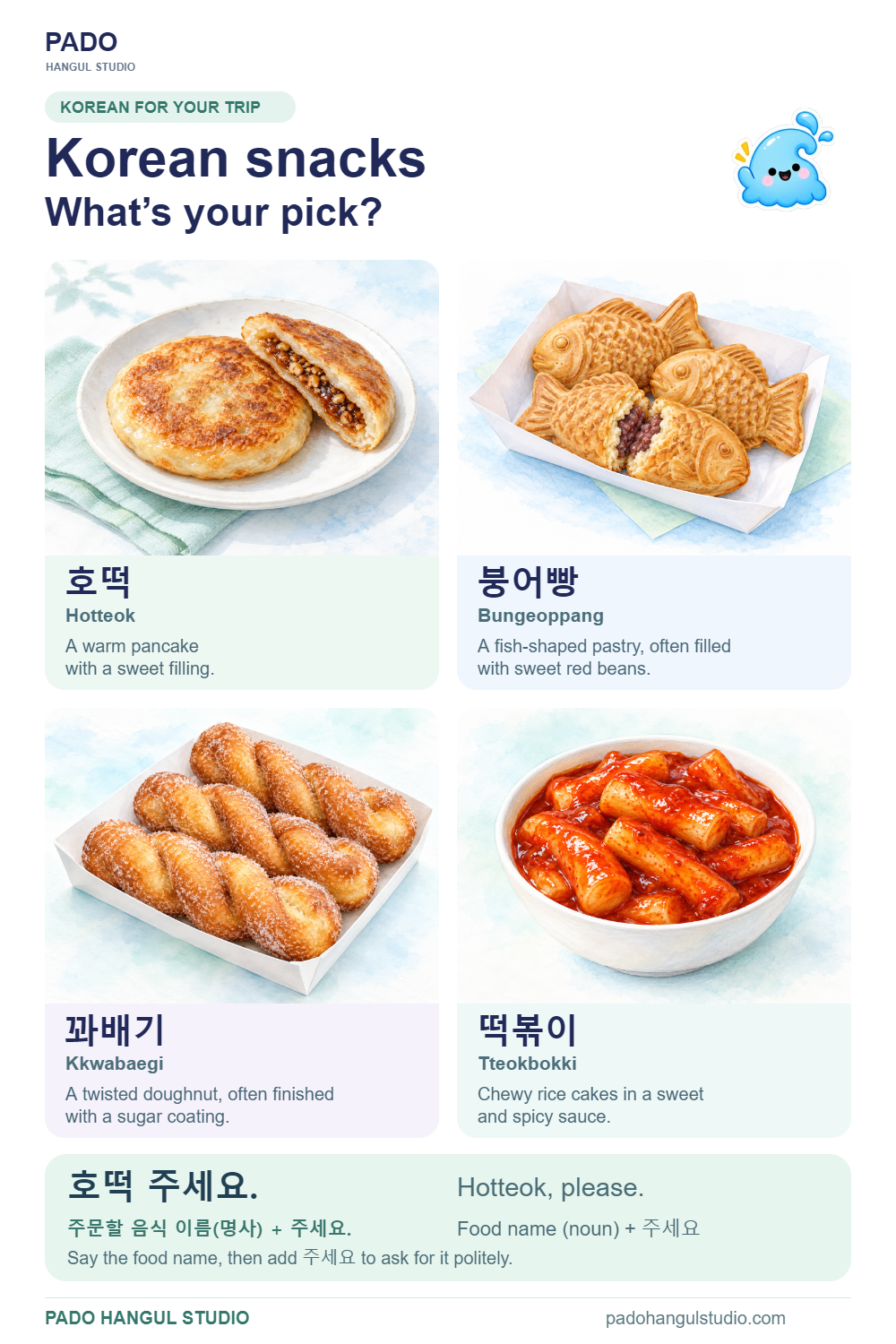
Meet four Korean snacks: 호떡 (hotteok), 붕어빵 (bungeoppang), 꽈배기 (kkwabaegi), and 떡볶이 (tteokbokki). 💙
A food name is a noun. Add 주세요 to order politely:
호떡 주세요. — Hotteok, please.
Swap the food name and try it again. Which snack would you order first?
#LearnKorean #KoreanSnacks #KoreaTravel
続きを読む →Travel light, find what you lost 💙 | Travel Korean 2/2
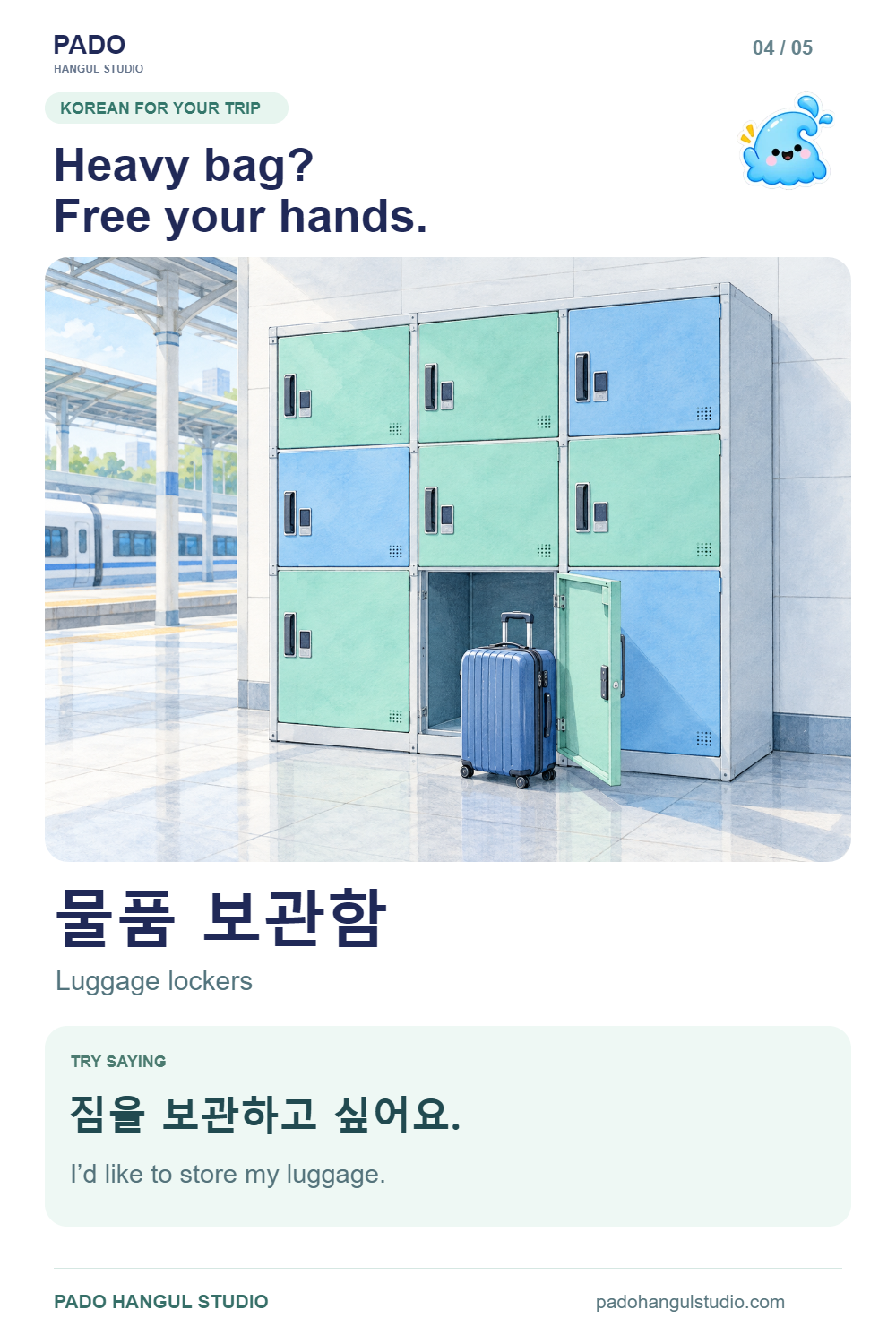
A heavy bag and a missing bag call for different places. 💙
Use 물품 보관함 to store your belongings. Ask at the 분실물 센터 when you have lost something.
짐을 보관하고 싶어요.
I’d like to store my luggage.
물건을 잃어버렸어요.
I’ve lost something.
💬 Quick question
You still have your suitcase, but want to leave it somewhere while you explore. Which place would you look for?
Save these cards for your next Korea trip.
Practice more Korean words:
https://padohangulstudio.com/vocabulary?lang=en
#LearnKorean #KoreaTravel #KoreanVocabulary
続きを読む →Find the place you need in Korea 💙 | Travel Korean 1/2
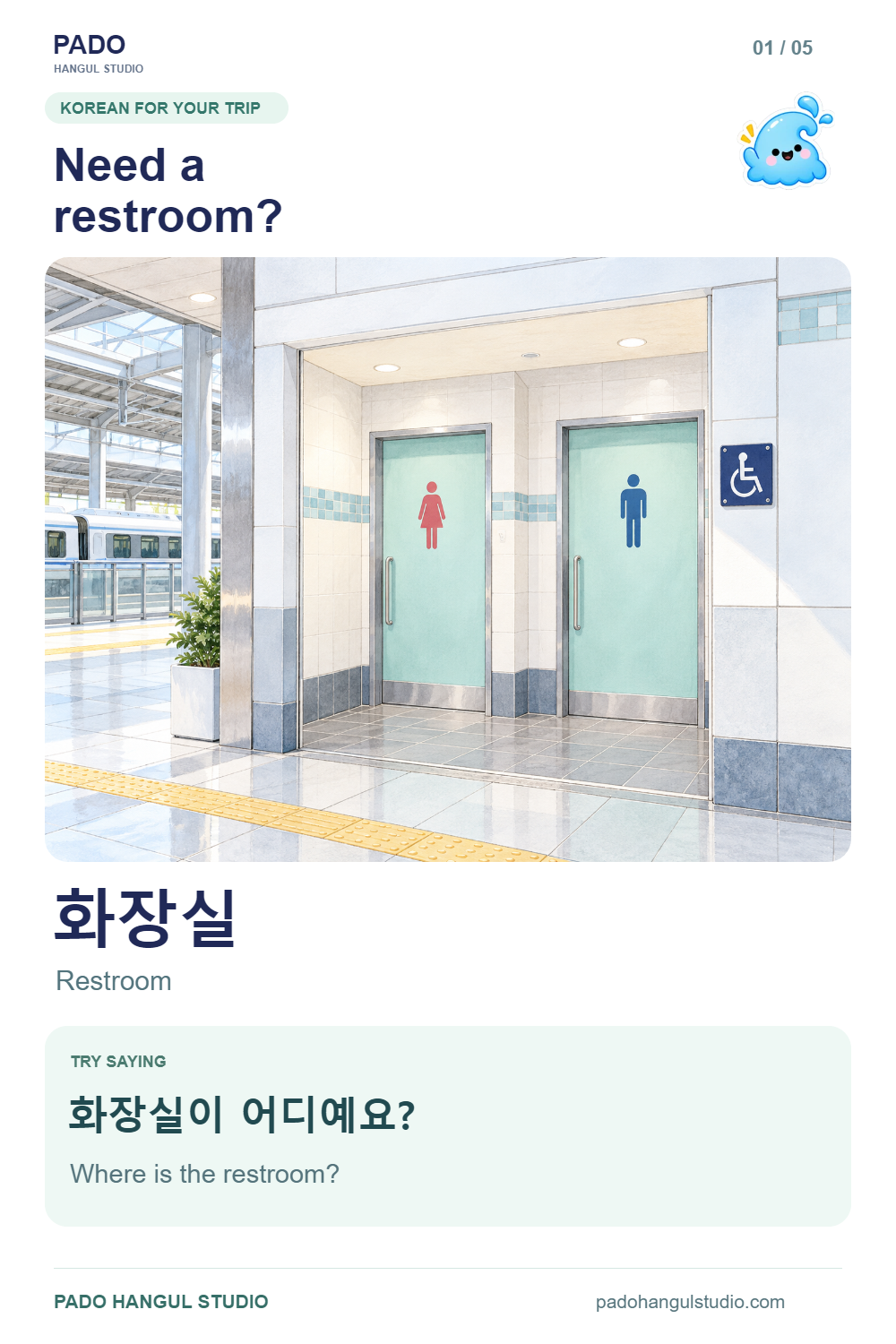
Looking for a restroom, an exit, or a pharmacy? 💙
Learn three useful place names and a short phrase for each.
화장실이 어디예요?
Where is the restroom?
💬 Quick question
Which place would you look for if you needed to buy medicine? Try its Korean name.
Next: storing your bag and finding something you lost.
Practice more Korean words:
https://padohangulstudio.com/vocabulary?lang=en
#LearnKorean #KoreaTravel #KoreanVocabulary
続きを読む →Close Relatives | Korean Family Trees 4/4
編集済み ·
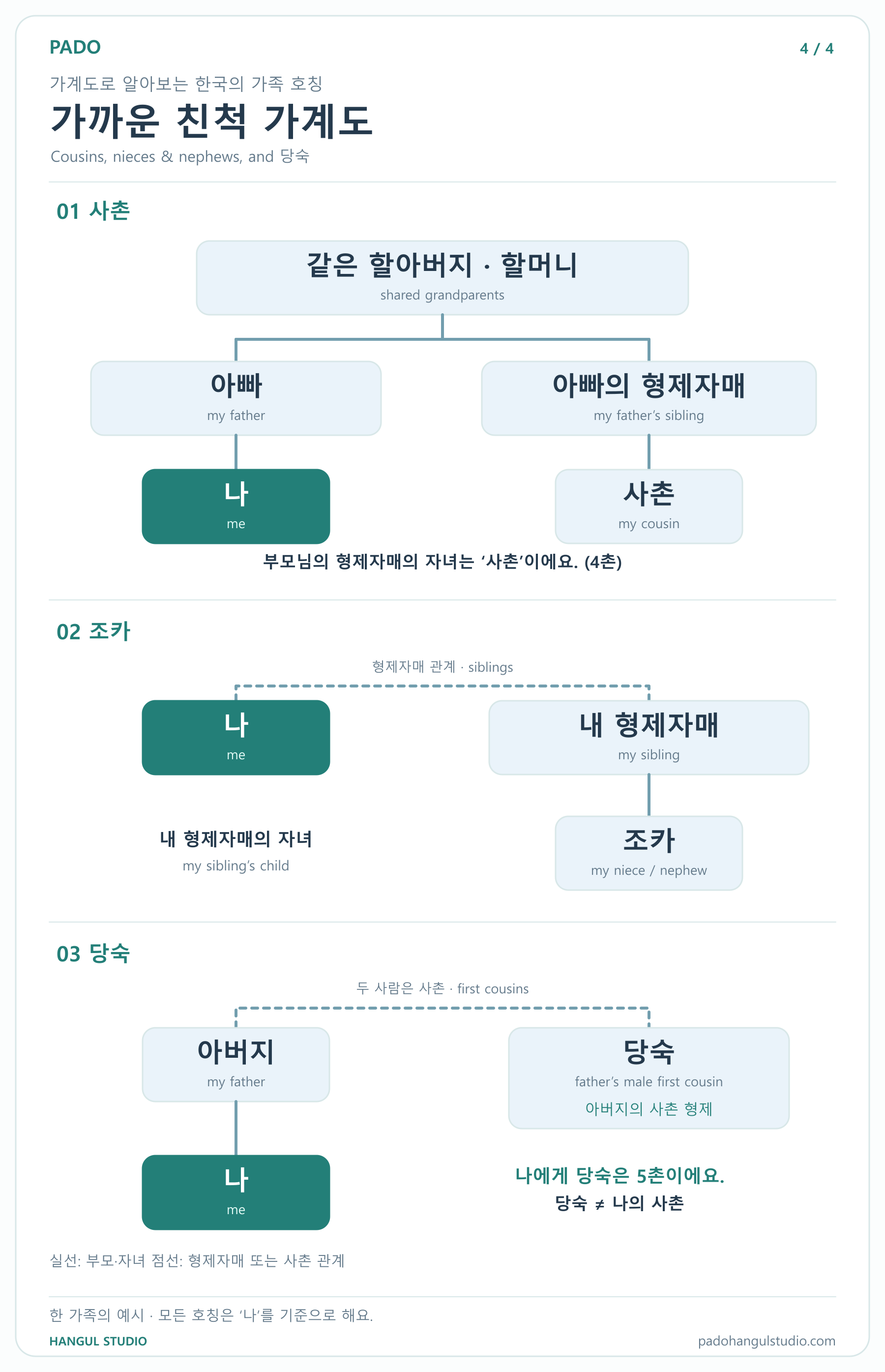
Cousins, nieces and nephews, and a parent’s cousin belong to different parts of a family tree. This chart shows three separate relationship examples.
1. 사촌: a child of your parent’s sibling — your first cousin.
2. 조카: your sibling’s child — your niece or nephew.
3. 당숙: your father’s male first cousin. He belongs to your father’s generation, not your generation. In the Korean kinship counting system, 사촌 is four steps away and 당숙 is five.
Solid lines show parent–child links; dashed lines show siblings or first cousins. Actual forms of address may vary by family.
💬 Quick question
Is your sibling’s child 사촌 or 조카? Choose one word you learned from this four-part series.
Practice more family words: https://padohangulstudio.com/vocabulary?lang=en&category=people-family
#LearnKorean #KoreanFamily #FamilyTree
続きを読む →Mother’s Side | Korean Family Trees 3/4
編集済み ·
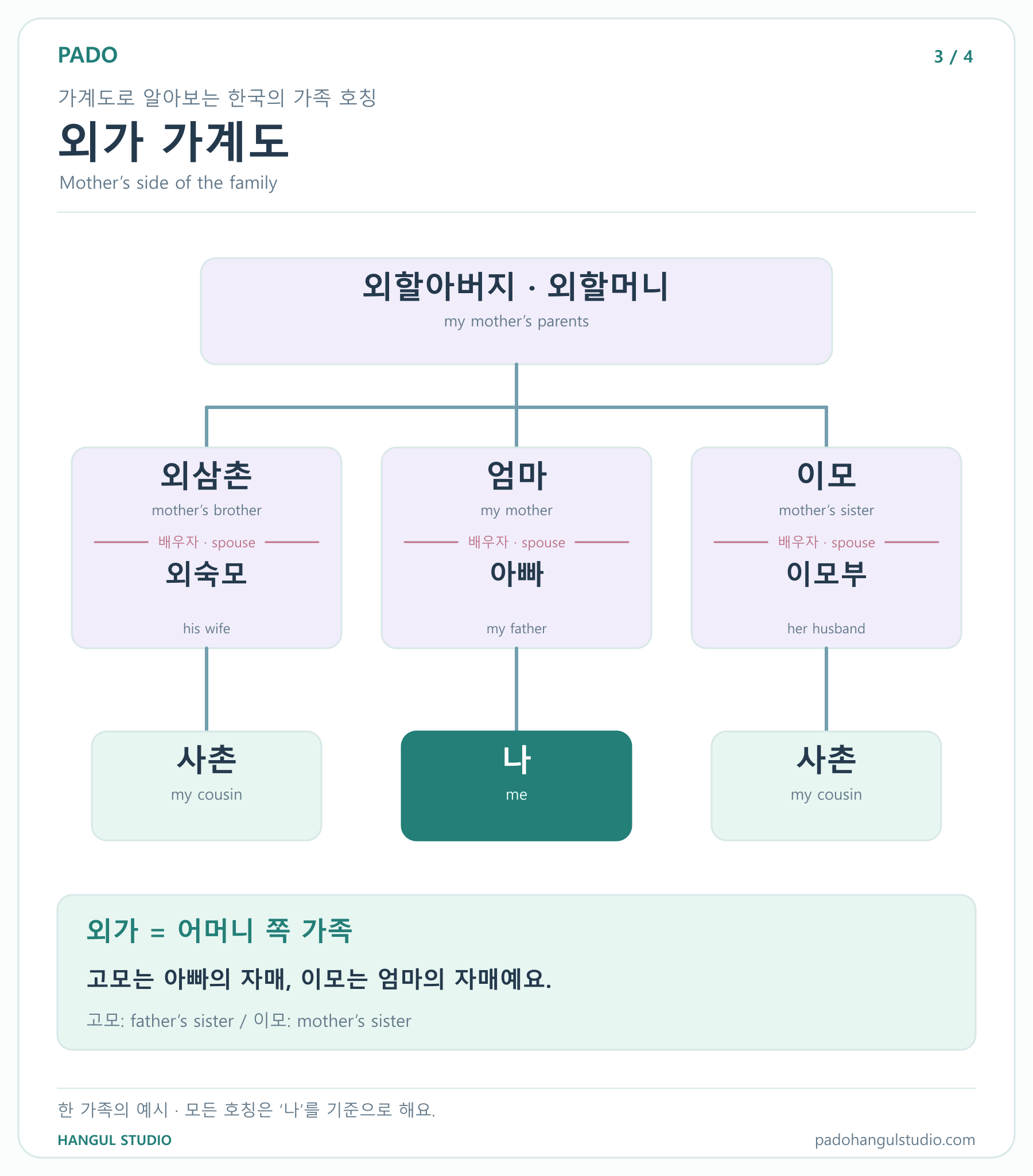
Explore the mother’s side of the family, called 외가. Begin with 외할아버지 and 외할머니, the maternal grandparents, and find 외삼촌 and 이모.
외삼촌: mother’s brother; 외숙모: his wife
이모: mother’s sister; 이모부: her husband
A useful contrast: 고모 is the father’s sister, while 이모 is the mother’s sister.
💬 Quick question
Is your mother’s sister 고모 or 이모? Try one Korean word.
This is one example family, viewed from “me.” Next: cousins, nieces and nephews, and 당숙.
Practice more family words: https://padohangulstudio.com/vocabulary?lang=en&category=people-family
#LearnKorean #KoreanFamily #FamilyTree
続きを読む →Father’s Side | Korean Family Trees 2/4
編集済み ·
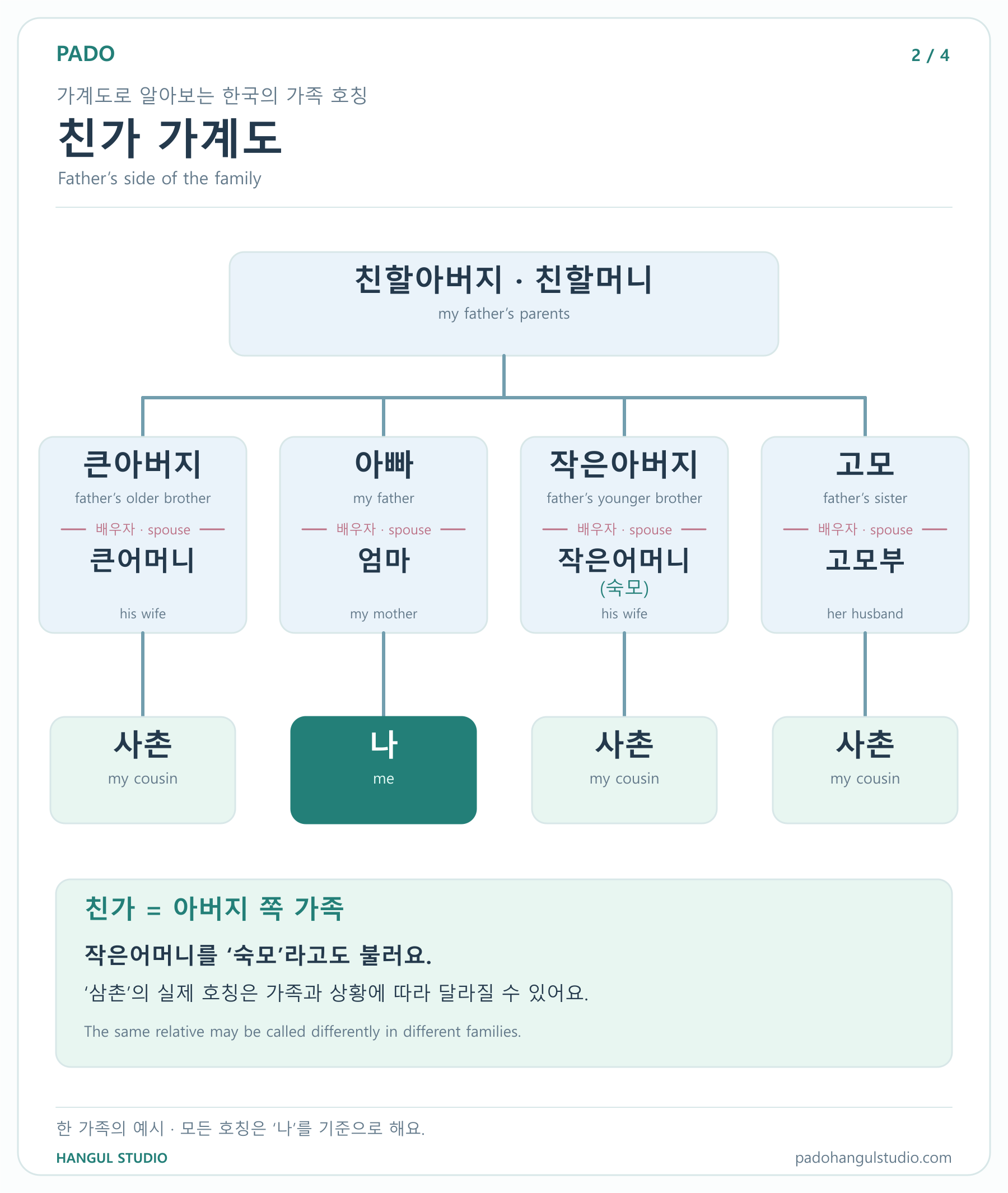
Explore the father’s side of the family, called 친가. Follow the lines down from 친할아버지 and 친할머니, the paternal grandparents.
큰아버지: father’s older brother; 큰어머니: his wife
작은아버지: father’s younger brother; 작은어머니 / 숙모: his wife
고모: father’s sister; 고모부: her husband
사촌: a child of your parent’s sibling — your first cousin
The pink “spouse” label marks a marriage. Actual forms of address, including 삼촌, can differ by family and situation.
💬 Quick question
What do you call your 고모’s husband? Find the answer in the chart.
This is one example family, viewed from “me.” Next: the mother’s side.
Practice more family words: https://padohangulstudio.com/vocabulary?lang=en&category=people-family
#LearnKorean #KoreanFamily #FamilyTree
続きを読む →My Family | Korean Family Trees 1/4
編集済み ·
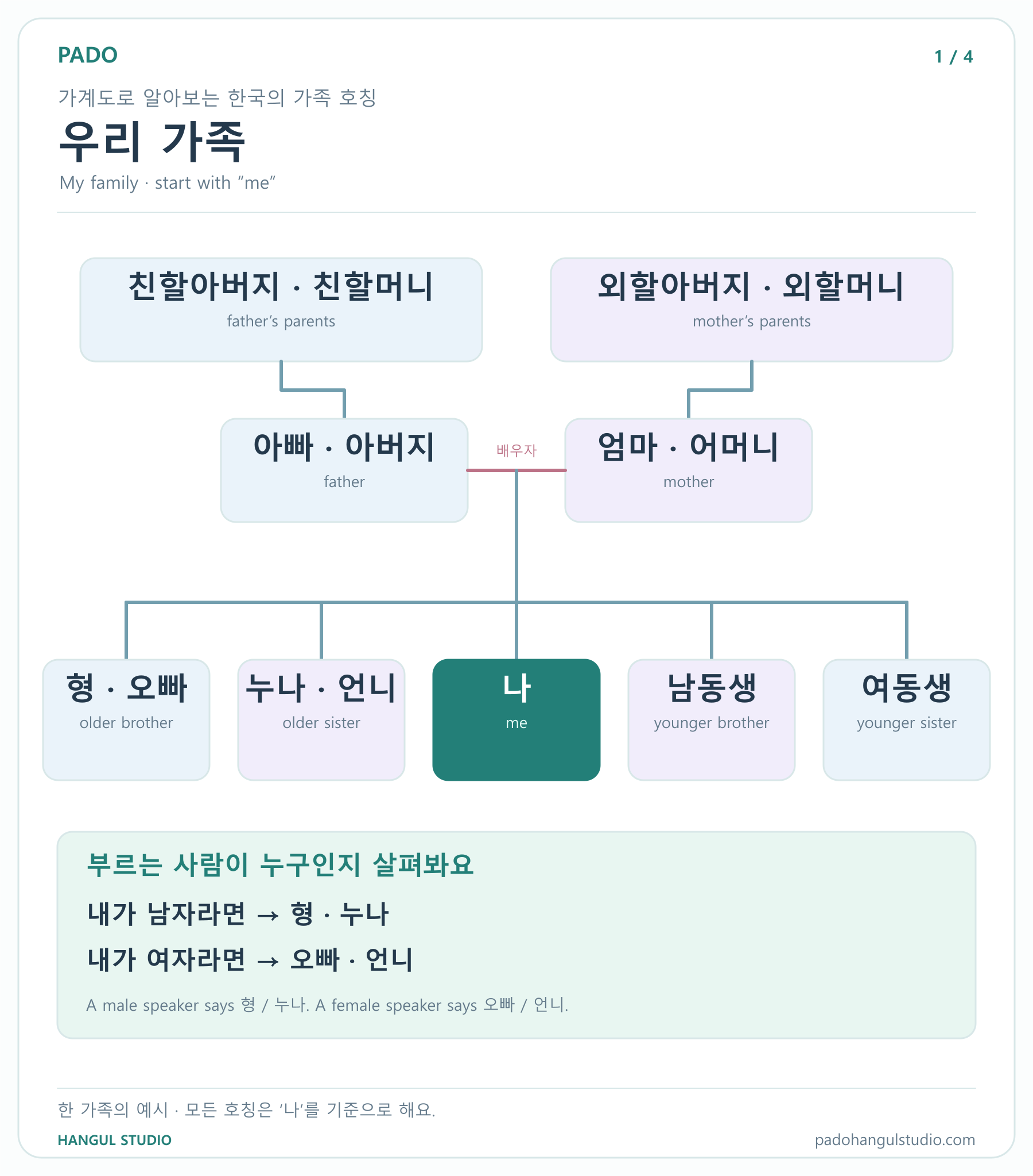
Who is who in a Korean family? Start with the green “me” box and follow the lines upward. The chart shows different terms for grandparents on the father’s and mother’s sides.
A male speaker calls an older brother 형 and an older sister 누나. A female speaker uses 오빠 and 언니. 남동생 and 여동생 mean younger brother and younger sister.
💬 Quick question
What does a female speaker call her older sister? Try one Korean word.
This is one example family. Every label is shown from “my” point of view. Next: the father’s side.
Practice more family words: https://padohangulstudio.com/vocabulary?lang=en&category=people-family
#LearnKorean #KoreanFamily #FamilyTree
続きを読む →Count for a picnic 🧺
編集済み ·
Ready for a weekend picnic? 🧺
Look at the three story cards and answer two picture questions on each one. Card 3 is a video card: press play to hear all six quantity phrases. Count first, then check the answers below.
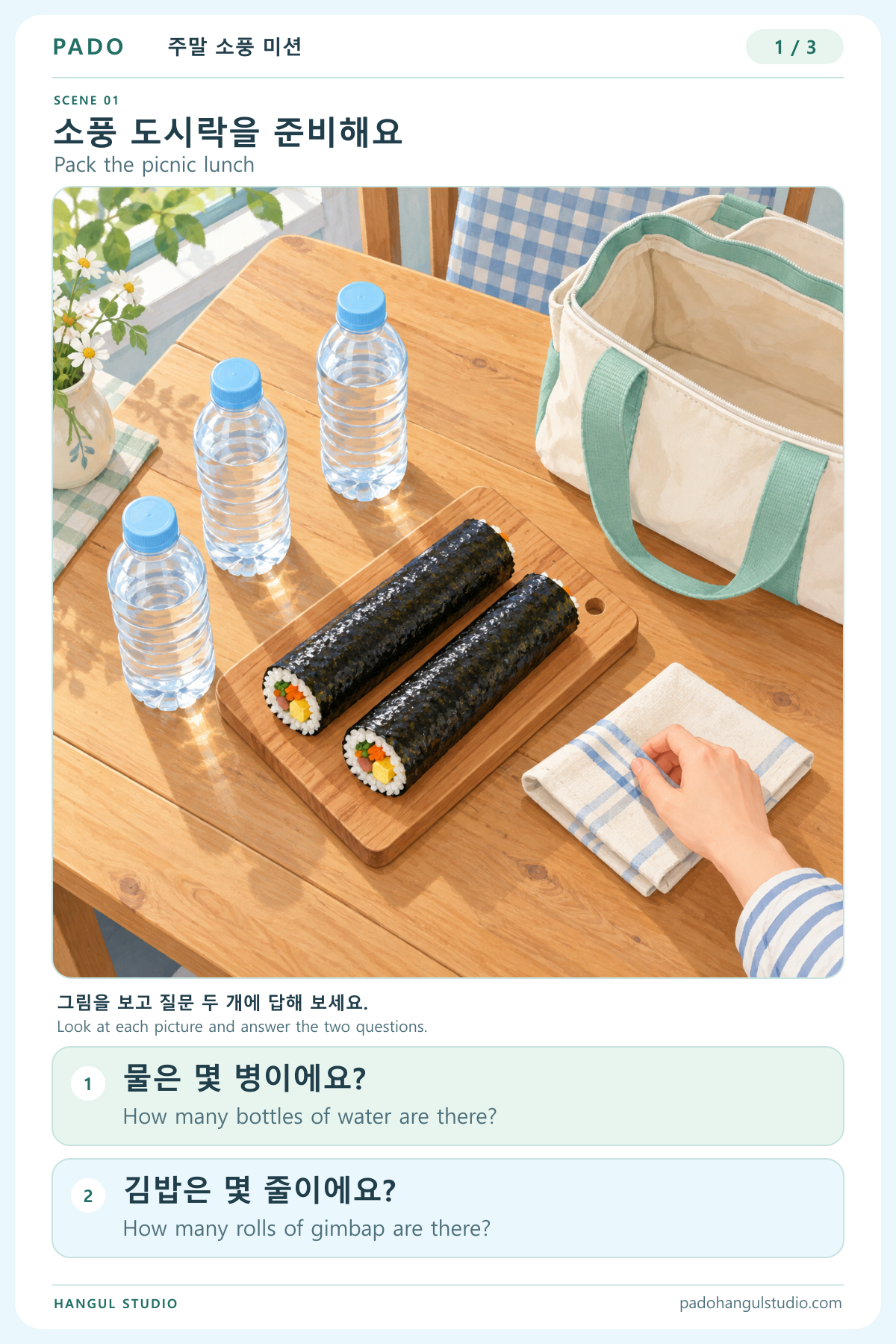
1. Pack the lunch: How many bottles of water are there? How many rolls of gimbap?
2. Check the bag: How many apples are there? How many picnic mats?
3. Meet in the park: How many friends are in the picture altogether? How many dogs?
Try one answer in a comment or say it aloud.
Example: There are four apples.
Answers
1. Three bottles of water and two rolls of gimbap.
2. Four apples and one picnic mat.
3. Three friends and two dogs.
Count the two whole gimbap rolls, not individual slices. The folded mat is still one mat. Play the third video card to hear the Korean narration and repeat the quantity phrases.
#LearnKorean #KoreanCounters #KoreanVocabulary
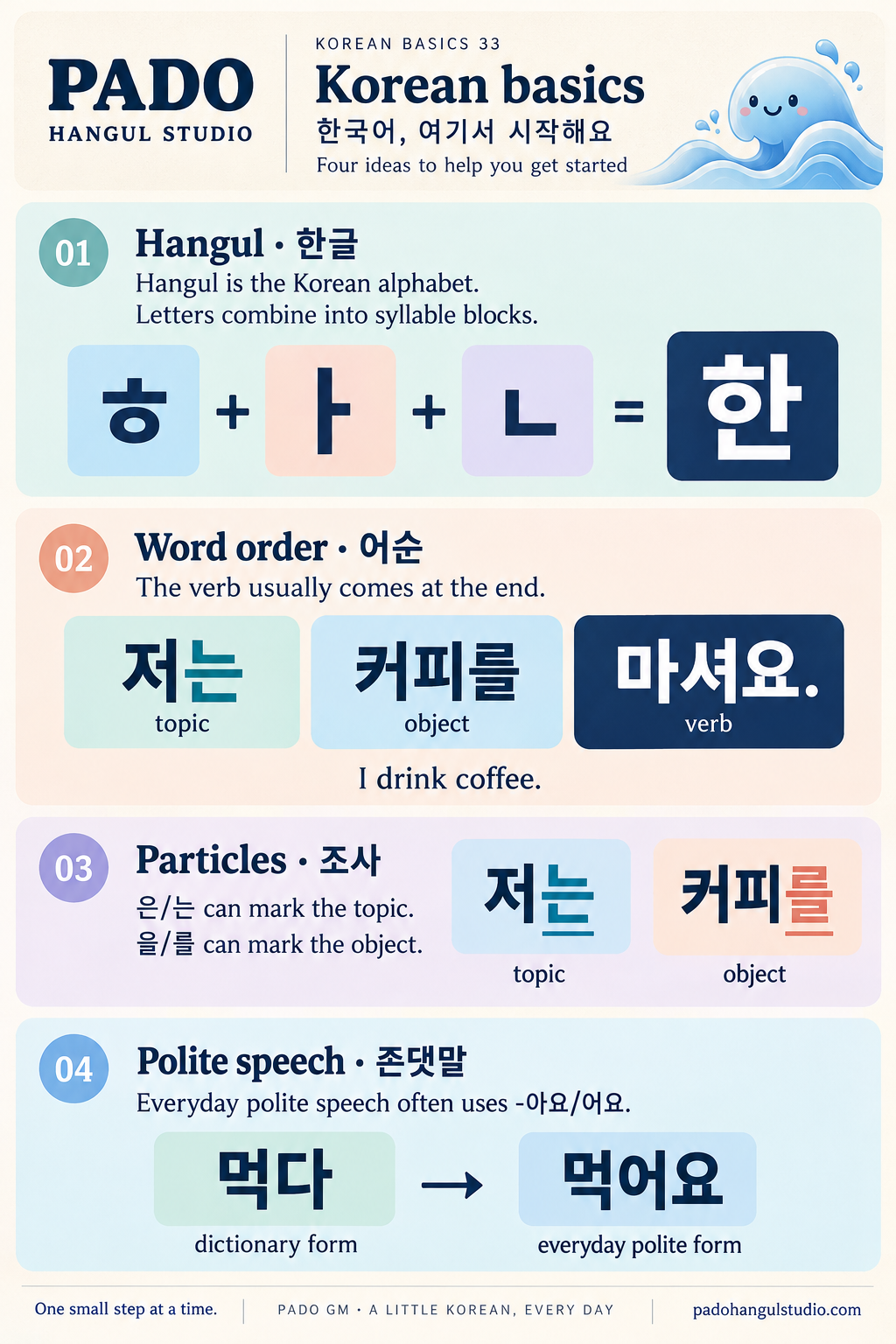
続きを読む →New to Korean? Start here. 💙
New to Korean? Start here. 💙
Get to know four basics: Hangul, word order, particles, and polite speech.
One short sentence can teach you a lot:
저는 커피를 마셔요.
I drink coffee.
Which topic would you like to explore next?
#LearnKorean #KoreanBasics #Hangul #KoreanGrammar
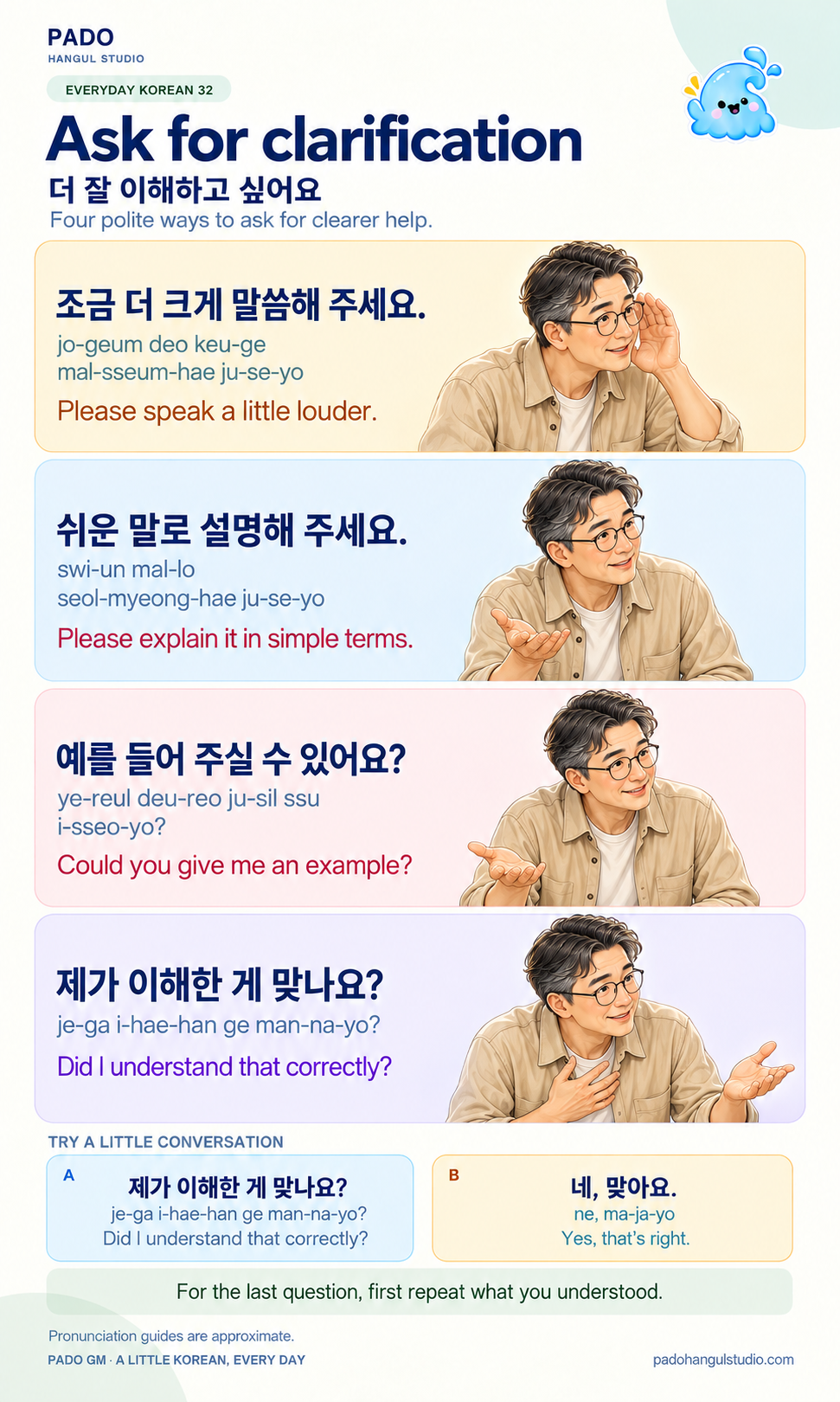
続きを読む →Four polite ways to ask for help in Korean 💙
It’s okay to ask for a little help. 💙
Practice four polite Korean phrases to keep the conversation going.
예를 들어 주실 수 있어요?
Could you give me an example?
Which phrase would you use first?
#LearnKorean #KoreanPhrases #KoreanConversation
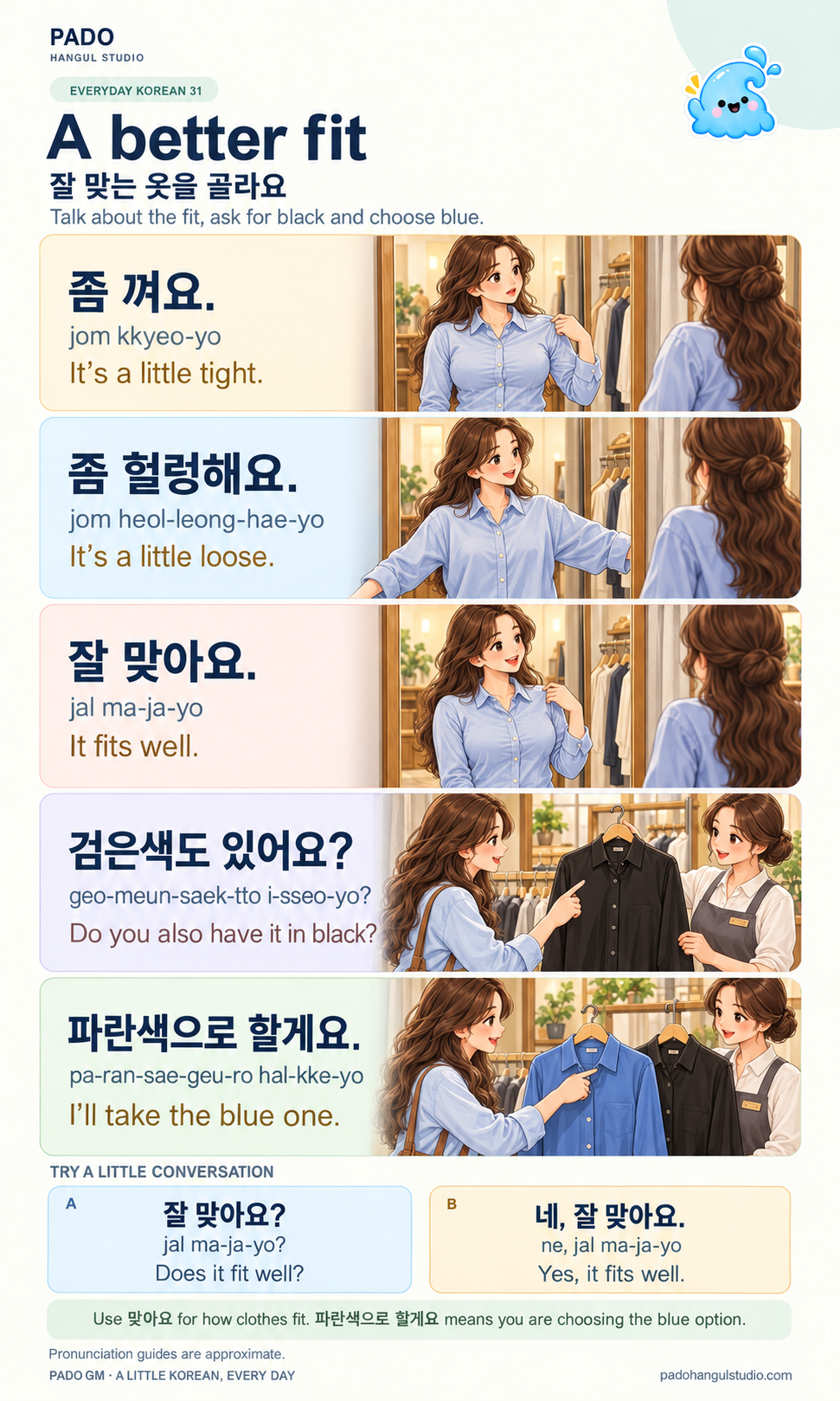
続きを読む →Find the right fit—and choose your colour 💙
A little tight, a little loose, or just right?
Practice five useful phrases for trying clothes and choosing a colour.
잘 맞아요? — Does it fit well?
Try saying which colour you would choose. 💙
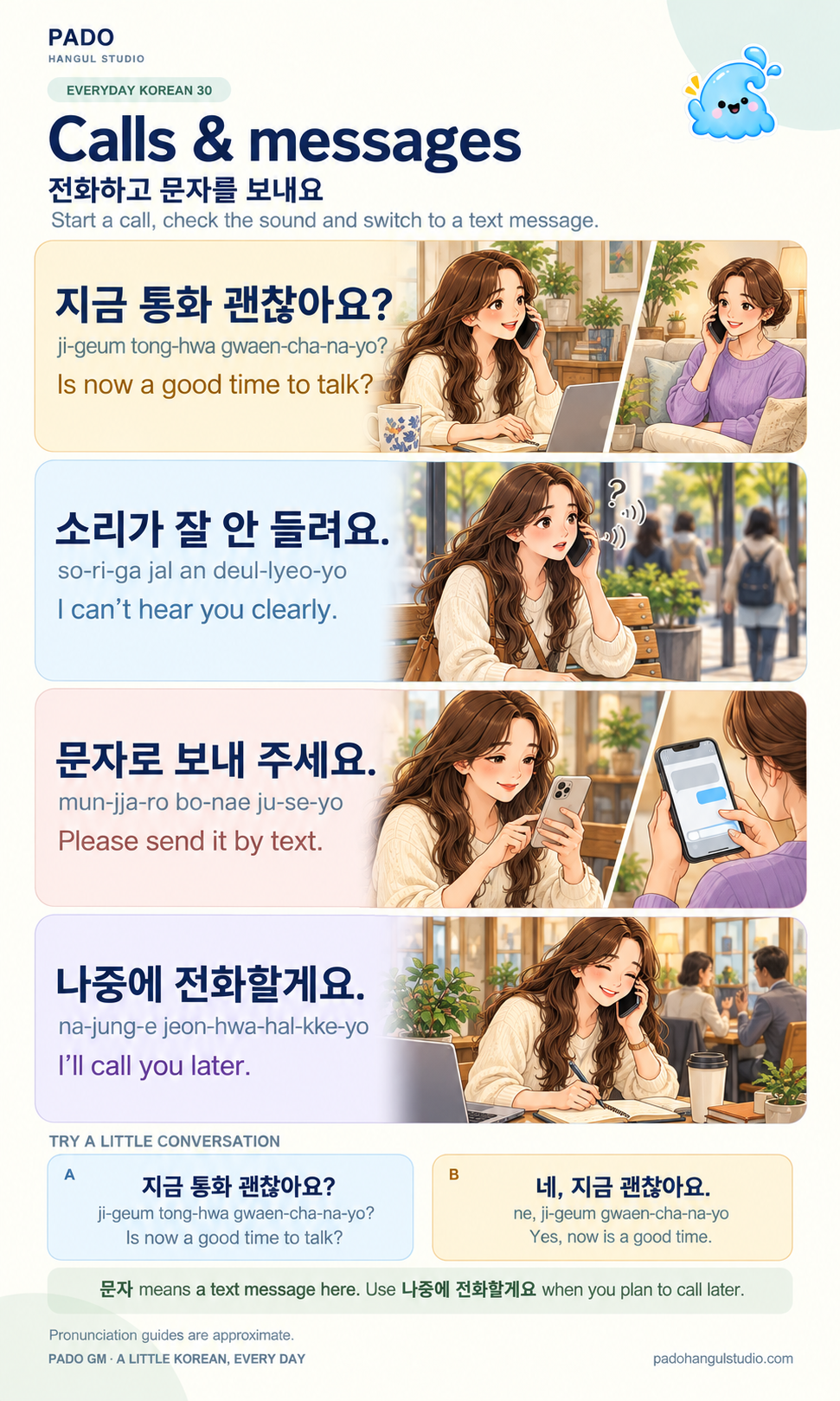
続きを読む →A little Korean for calls and texts 📱
Is now a good time to talk? What if the sound is unclear?
Practice four phrases for everyday phone calls and text messages.
문자로 보내 주세요. — Please send it by text.
Try one line aloud before your next call. 💙
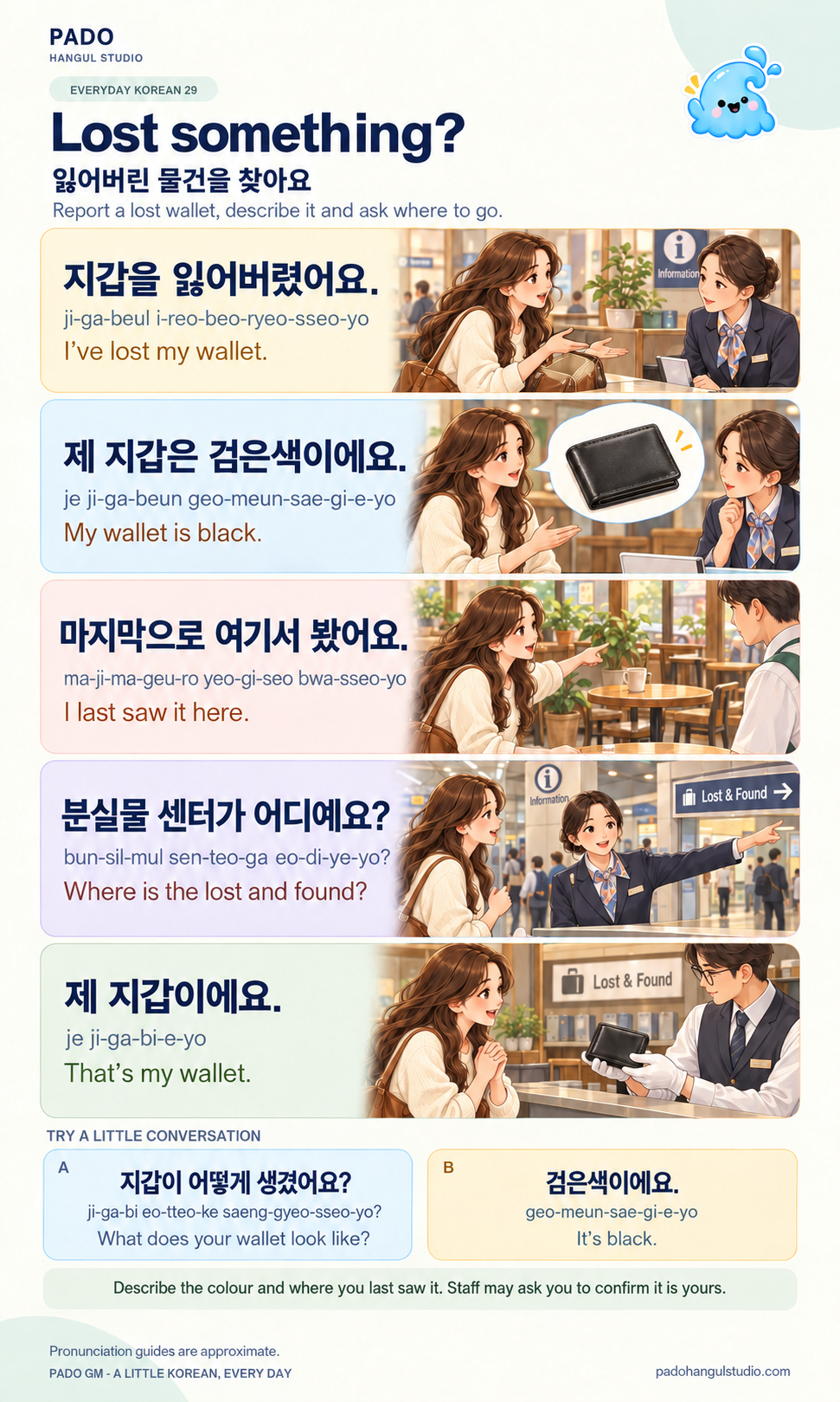
続きを読む →Lost your wallet? Five Korean phrases to help 💙
Say what you lost, describe it and ask for the lost and found.
Follow one simple wallet story through five useful phrases.
제 지갑은 검은색이에요. — My wallet is black.
Try describing a bag or wallet you use every day. 💙
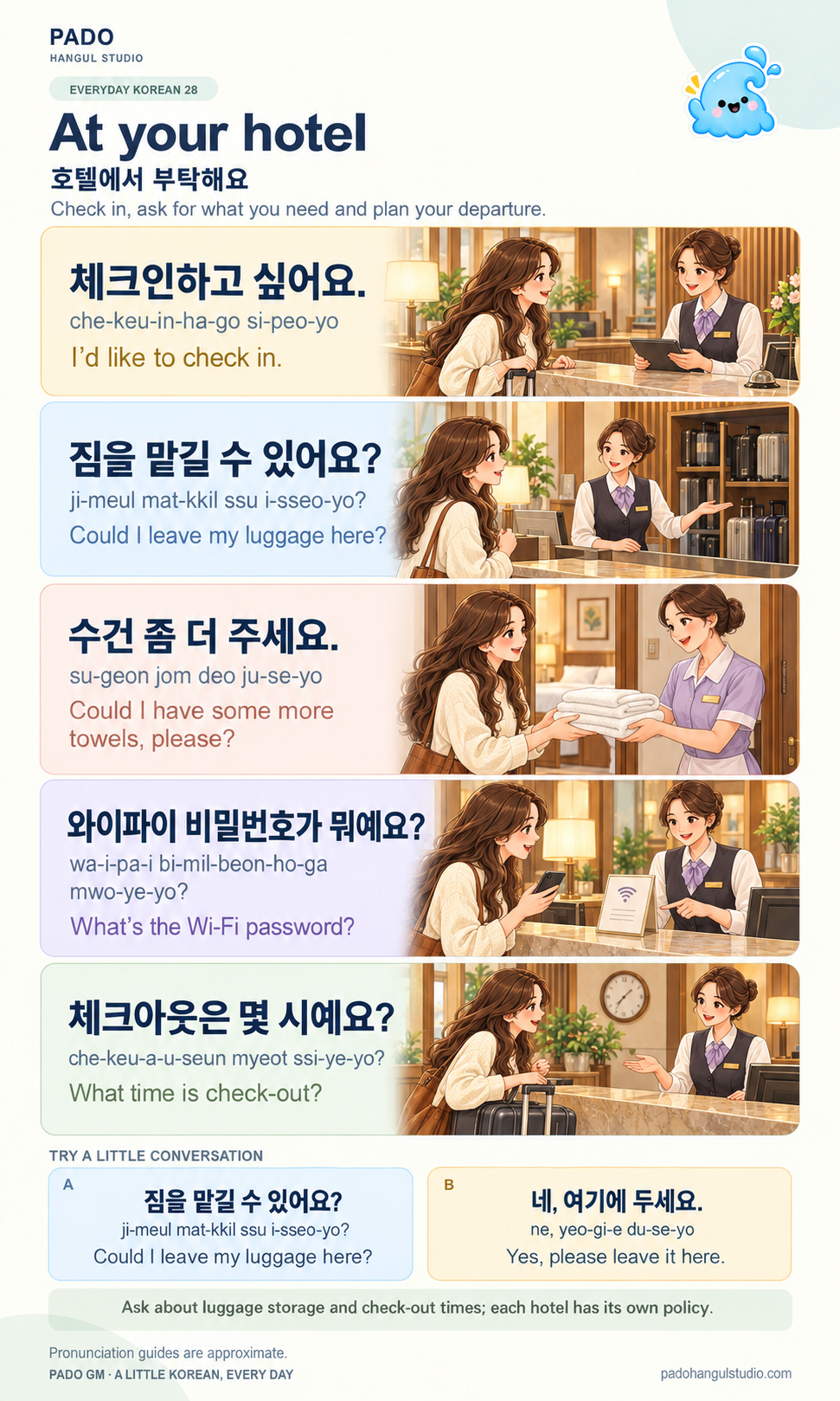
続きを読む →A smoother hotel stay, in Korean 🧳
Checking in or asking for a little help at your hotel?
Practice five polite phrases for luggage, towels, Wi-Fi and check-out.
짐을 맡길 수 있어요? — Could I leave my luggage here?
Save this for your next stay. 💙
続きを読む →